BASI ski instructor qualifications offer a world-recognised pathway to teaching skiing and building a global snowsports career.

BASI (the British Association of Snowsports Instructors) was founded in 1963 and is the UK’s national governing body for training and certifying snowsports instructors. They provide courses across five disciplines, Alpine skiing, snowboarding, adaptive, telemark, and cross-country. All designed to help you teach around the world. In this guide, we break down exactly how the BASI system works for aspiring Alpine ski instructors.
What Is BASI? Your Gateway to Teaching Skiing Worldwide
Founded in 1963, the British Association of Snowsports Instructors (BASI) is the UK’s official body for training and certifying snowsports instructors. While rooted in the UK, BASI has a strong international reputation, with many instructors working across Canada, Europe, Japan, New Zealand, and beyond.
As a member of the International Ski Instructors Association (ISIA), BASI offers four progressive levels of Alpine ski instructor qualifications that are recognised and respected worldwide. Known for their high standards and comprehensive training, BASI-qualified instructors are in demand at ski schools across the globe, making it an excellent choice if you dream of turning your passion for skiing into a global career.
BASI Qualifications Explained: Levels, Progression & Where They Take You
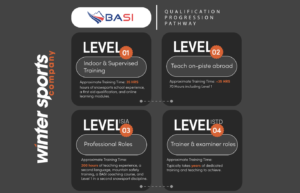
Like many international systems within ISIA, BASI uses a structured four-level qualification pathway. Each level builds on your technical skills, teaching ability, and mountain experience, opening doors to instructing opportunities across the globe.
BASI Level 1: Your First Step into Teaching
The BASI Level 1 course is perfect if you’re looking to get started as an instructor. – A four-day training and assessment course. – Includes a first aid qualification, 35 hours of snowsports school experience, and online learning modules. – Level 1 instructors typically work at indoor snow centres in the UK or under supervision in ski schools abroad.
BASI Level 2: Teach on the Mountain
Ready to move on to real mountains? Level 2 enables you to teach more advanced skiers on international marked pistes. – An eight-day training and assessment course. – Requires an additional 35 hours of snowsports school experience (on top of Level 1 hours). – You’ll refine your technical skills, learn to demonstrate for intermediate to parallel skiers, and gain more independence as an instructor.
BASI Level 3 ISIA: Become a Professional
This is where you step up to a professional, full-season instructor career. – Awards the International Ski Instructor Association (ISIA) stamp. – Requires 200 hours of teaching experience, a second language, mountain safety training, a BASI coaching course, and Level 1 in a second snowsport discipline. – Level 3 opens up more countries and higher-level roles in ski schools.
BASI Level 4 ISTD: Join the Elite
The highest certification you can achieve, Level 4 (ISTD), recognises you as one of the best instructors worldwide. – Extensive technical and teaching modules. – Opens opportunities to become a trainer and course examiner. – Typically takes years of dedicated training and teaching to achieve. – Unlocks long-term, sustainable career pathways in the industry, including top-level international roles.
– Level 4 certifications are hosted by the governing body itself.
Where can BASI qualifications take you?
With each level, you expand where and who you can teach, from beginners in UK snowdomes to expert skiers on the world’s best mountains. BASI qualifications are respected globally and can help turn your passion for skiing into a true worldwide career.
Course Costs & Options: Investing in Your BASI Ski Instructor Future
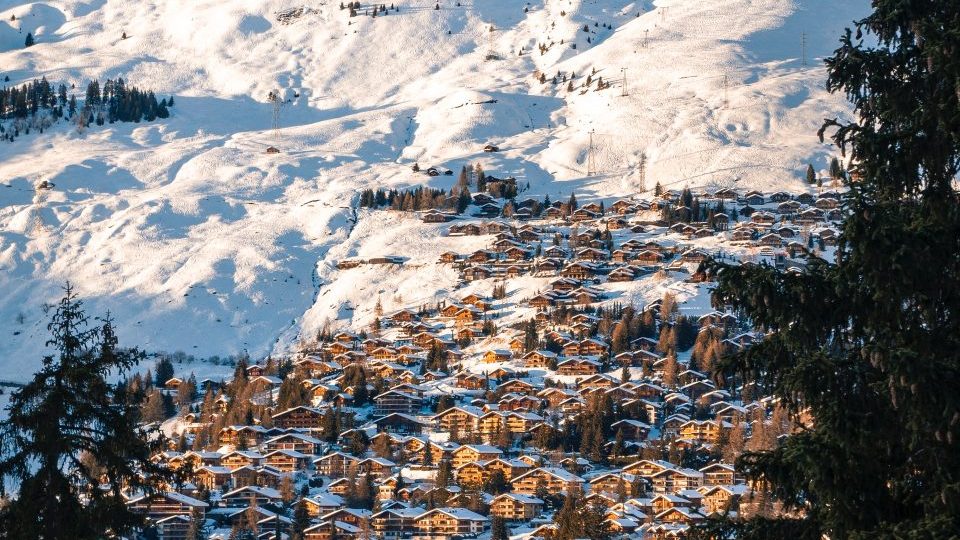
At Winter Sports Company, we offer comprehensive BASI Level 1 and 2 instructor courses in two incredible locations: the world-famous Verbier in Switzerland and multiple resorts across Canada.
While the course fee of £10,600 for Verbier might look high at first glance, it’s designed to provide exceptional value and everything you need to kick-start your instructor career confidently.
What’s included?
10 weeks of intensive training with experienced BASI Level 4 instructors.
BASI membership and Level 1 exam fees.
Private chalet or shared accommodation (depending on location).
Meal plans (typically five days a week).
Full season lift pass.. (course dependent)
Whether you choose the iconic Swiss Alps or the stunning resorts across Canada, you’ll get an immersive, supportive experience that sets you up for success on and off the mountain.
Where Can a BASI Qualification Take You? Global Job Opportunities
A BASI qualification isn’t just a certificate, it’s your ticket to teaching and travelling across the world.
Because BASI operates under the International Ski Instructors Association (ISIA), its qualifications are recognised and respected globally. Whether you’re starting out or aiming for the top, each level unlocks new destinations and job opportunities.
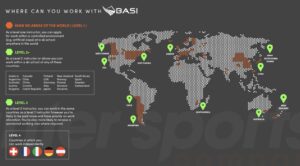
Where can you work with each level?
Level 1: Begin your journey by teaching beginners on indoor slopes in the UK or at mountain resorts under close supervision. It’s the perfect first step to build your confidence and gain essential teaching experience.
Level 2: Open doors to work in international ski schools across Europe, Canada, Japan, and beyond. You’ll take on more responsibility and independence, and many schools offer in-house training to help you develop further.
Levels 3 & 4: These top levels make you a true industry professional. Level 3 instructors are highly sought after at premium resorts worldwide, while Level 4 (ISTD) holders can move into trainer and examiner roles, coach new instructors, and enjoy higher earning potential.
Working abroad is an incredible way to keep improving your skills, meet new people from around the world, and live your passion every single day.
Check out our guides below for CSIA, CASI, SBINZ, and NZSIA qualifications to compare your options.
Other Pathways: How BASI Compares to Global Instructor Systems
While BASI is one of the most respected instructor qualifications in the world, it isn’t the only option if you’re looking to teach skiing or snowboarding abroad.
In Canada, the Canadian Ski Instructors’ Alliance (CSIA) is the main governing body, and in New Zealand, it’s the New Zealand Snowsports Instructors Alliance (NZSIA). Each system has its own structure, level progression, and recognition in different parts of the world.
BASI stands out for its strong ties to the International Ski Instructors Association (ISIA), rigorous technical standards, and broad global recognition. This makes it an excellent choice if you’re dreaming of a truly international career, moving between Europe, Japan, Canada, and beyond.
If above 15, given the right attitude and ability, anyone can be a ski instructor. Training through a provider like the Winter Sports Company can ensure a speedy journey to becoming a ski instructor. Embarking on an intense training programme is a surefire way of learning the correct methods and, more importantly, understanding one’s strengths and weaknesses so that the student can improve through learning, practising and teaching the techniques and skills associated with a ski instructor.
How much can I earn as a BASI ski instructor?
Earnings vary by country, resort, and level. Entry-level instructors typically cover living costs and enjoy seasonal perks like free lift passes and accommodation. At higher levels (Level 3 and 4), instructors can earn significantly more and access premium roles, including trainer and examiner positions. Earnings can range from around £1,200 to over £3,000 per month, depending on your BASI level, location, and experience.
Can You Become A Ski Instructor With No Experience?
This wouldn’t be easy to achieve without proper training and certification by a governing body or a ski instructor provider such as the Winter Sports Company. Internationally recognised ski schools will always employ people who have been professionally trained to a standard accepted by the governing body recognised in that country. Additionally, the resort or ski school will likely not allow an unqualified, uninsured person with zero experience to teach on the mountain. Fortunately The Winter Sports Company can teach complete beginners to become ski instructors in as little as 6 weeks.
Do I need to speak another language to work abroad with BASI?
For Level 3 and above, a second language is required if you want to qualify for the ISIA stamp. Even at Level 2, learning another language can increase your chances of getting hired in non-English speaking resorts.
Can I work year-round as a ski instructor?
Yes! Many instructors work in the northern hemisphere during winter (December–April) and then head south (New Zealand, Australia, South America) for their winter season (June–October), allowing them to teach and ski all year.
What are the lifestyle benefits of working as a ski instructor?
Besides earning an income, you’ll enjoy perks like daily skiing, free or discounted lift passes, staff accommodation, and the chance to live in beautiful mountain resorts. Many instructors also love the strong community and international friendships they build.
How long does it take to become a BASI Level 2 instructor?
Most people achieve BASI Level 2 after completing Level 1 and then progressing through an 8-day Level 2 course plus required teaching experience. With full-time training, this can be done in a single season (around 10–12 weeks).
Often referred to as the Admiral, she is the glue behind the scenes. Keeping the beating heart of the WSC pumping ensuring all operations are covered. With over 2 decades of experience with complex logistics and planning you will be glad that she is on your team. Found between the UK and Canada.
We use cookies on our website to give you the most relevant experience by remembering your preferences and repeat visits. By clicking “Accept All”, you consent to the use of ALL the cookies. However, you may visit "Cookie Settings" to provide a controlled consent.
This website uses cookies to improve your experience while you navigate through the website. Out of these, the cookies that are categorized as necessary are stored on your browser as they are essential for the working of basic functionalities of the website. We also use third-party cookies that help us analyze and understand how you use this website. These cookies will be stored in your browser only with your consent. You also have the option to opt-out of these cookies. But opting out of some of these cookies may affect your browsing experience.
Necessary cookies are absolutely essential for the website to function properly. These cookies ensure basic functionalities and security features of the website, anonymously.
Cookie
Duration
Description
cookielawinfo-checkbox-analytics
11 months
This cookie is set by GDPR Cookie Consent plugin. The cookie is used to store the user consent for the cookies in the category "Analytics".
cookielawinfo-checkbox-functional
11 months
The cookie is set by GDPR cookie consent to record the user consent for the cookies in the category "Functional".
cookielawinfo-checkbox-necessary
11 months
This cookie is set by GDPR Cookie Consent plugin. The cookies is used to store the user consent for the cookies in the category "Necessary".
cookielawinfo-checkbox-others
11 months
This cookie is set by GDPR Cookie Consent plugin. The cookie is used to store the user consent for the cookies in the category "Other.
cookielawinfo-checkbox-performance
11 months
This cookie is set by GDPR Cookie Consent plugin. The cookie is used to store the user consent for the cookies in the category "Performance".
viewed_cookie_policy
11 months
The cookie is set by the GDPR Cookie Consent plugin and is used to store whether or not user has consented to the use of cookies. It does not store any personal data.
Lorem ipsum dolor sit amet, consectetur adipiscing elit. Duis dapibus rutrum vulputate. Mauris sed eros nec est vehicula mattis ac vitae ligula. Maecenas vitae tristique sapien, vitae pellentesque lectus.